
中文
中文
On July 9, 2026, the Quantum Technology Application Scenario Release and Industry Matchmaking Conference, hosted by the Department of Science and Technology of Guangdong Province, was held in Guangzhou. The first three proof‑of‑concept projects under the industrial incubation platform of the Shenzhen International Quantum Academy of Sciences (IQASZ) were successfully signed and onboarded.
These projects cover three frontier directions: quantum–classical hybrid computing, miniaturized quantum inertial navigation, and indigenously developed quantum cryptography. Centered on scenario‑based proof of concept and technology iteration maturation, they aim to bridge the gap between laboratory research and industrial application in the quantum domain.
Located in the Hetao Shenzhen–Hong Kong Science and Technology Innovation Cooperation Zone, Futian District, Shenzhen, IQASZ serves as the operating entity of the Shenzhen branch of the National Laboratory for Quantum Information Science and a key basic research platform of Shenzhen. Its research focuses on four major areas: quantum state manipulation and quantum devices, quantum computing, quantum‑limited sensing, and quantum engineering applications. The Academy is committed to building a world‑class platform for both scientific research and technology transfer.
Leveraging the jointly established quantum industry incubation platform, this signing event addresses critical gaps in Guangdong Province’s quantum technology industrial chain—including proof of concept, pilot‑scale validation, and enterprise cultivation. It establishes a collaborative mechanism integrating research synergy, policy enablement, and market‑driven operations. Through systematic pre‑validation and process optimization of cutting‑edge quantum technologies, the initiative aims to refine mature technical solutions for diverse real‑world application scenarios, effectively resolving the longstanding challenge of adapting quantum research outputs to varied industrial contexts.
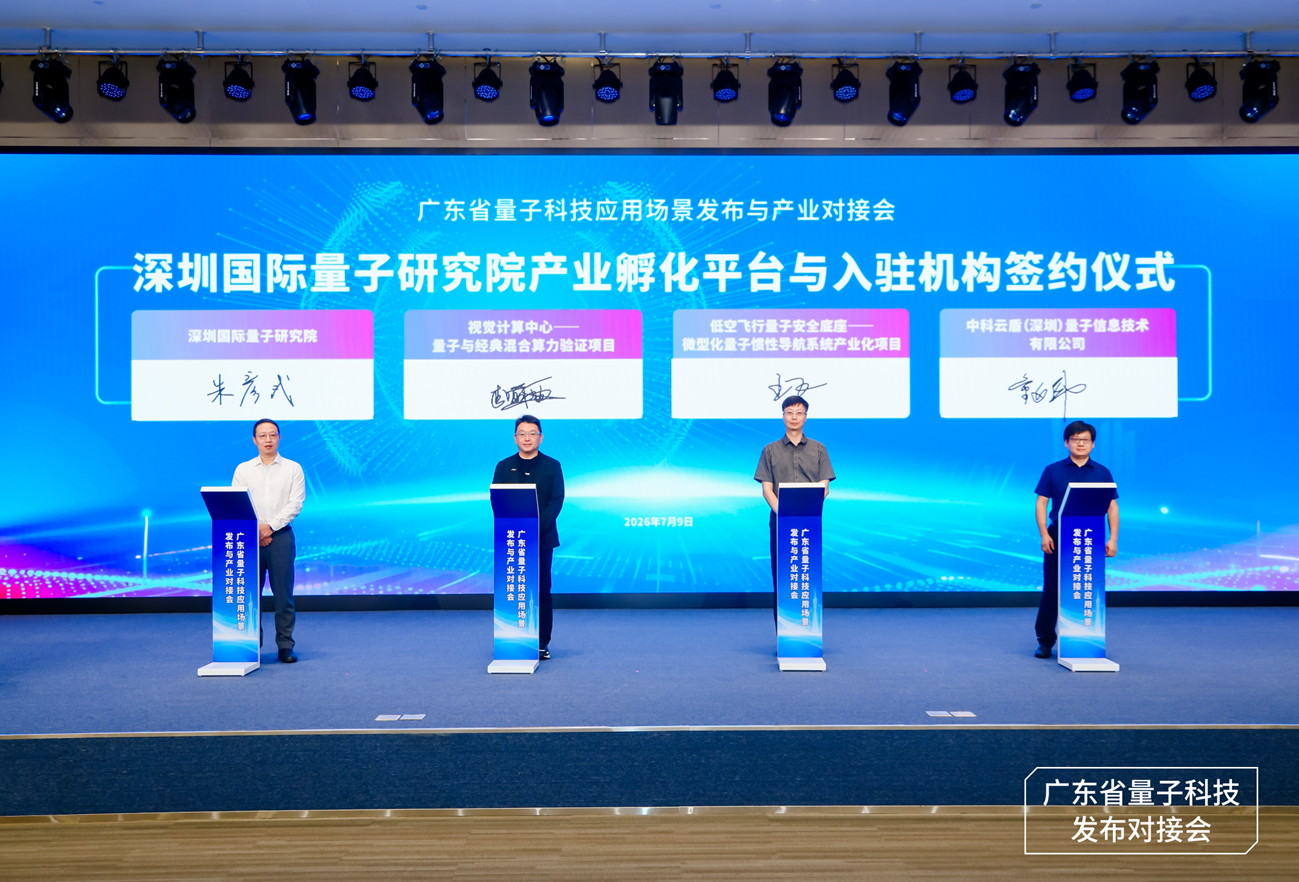
The onboarded projects are as follows:
? Quantum–Classical Hybrid Computing Project
Targeting the computational bottlenecks in digital twins, industrial simulation, and film/video rendering, this project develops heterogeneous quantum–classical computing scheduling technologies to deliver a new high‑efficiency, low‑power computing solution.
? Miniaturized Quantum Inertial Navigation Project (Joint Initiative)
Addressing the vulnerability of satellite navigation in low‑altitude economy scenarios—where signals are prone to interference or loss—this project establishes a joint collaborative exploration framework. It conducts forward‑looking research and feasibility studies for vehicle‑borne and airborne applications, pioneering new technological pathways for low‑altitude safety assurance.
? QPC Quantum Cryptography IoT Project
Adopting the indigenously developed QPC (Quantum Physical Cryptography) technology—which offers greater security and autonomy compared to overseas algorithmic cryptography—this project tackles core technologies including quantum chips and wireless key distribution, aiming to build a comprehensive quantum‑safe system for the Internet of Things.