
中文
中文
Rare-earth-ion-doped crystals exhibit excellent optical and spin coherence properties, making them an important material platform for solid-state quantum memory. Crystals with dilute rare-earth doping can exhibit long spin coherence times, but their weak optical absorption poses technical challenges for achieving high storage efficiencies. Although increasing the doping concentration can enhance optical absorption, it may also accelerate spin decoherence through stronger magnetic interactions between ions. Reconciling high optical depth with long-lived spin coherence has therefore remained one of the longstanding challenges in developing efficient, long-lived solid-state quantum memories.
To address this longstanding trade-off, the team investigated a stoichiometric EuCl3·6H2O single crystal. At zero magnetic field, the nuclear spin coherence time of Eu3+ was approximately 1.3 milliseconds. By precisely controlling the external magnetic field, the researchers tuned the system to a zero first-order Zeeman (ZEFOZ) operating point, where the transition frequency is insensitive to magnetic-field fluctuations to first order. This effectively suppressed decoherence caused by magnetic-field fluctuations and interionic interactions, extending the nuclear spin coherence time to 372 milliseconds.
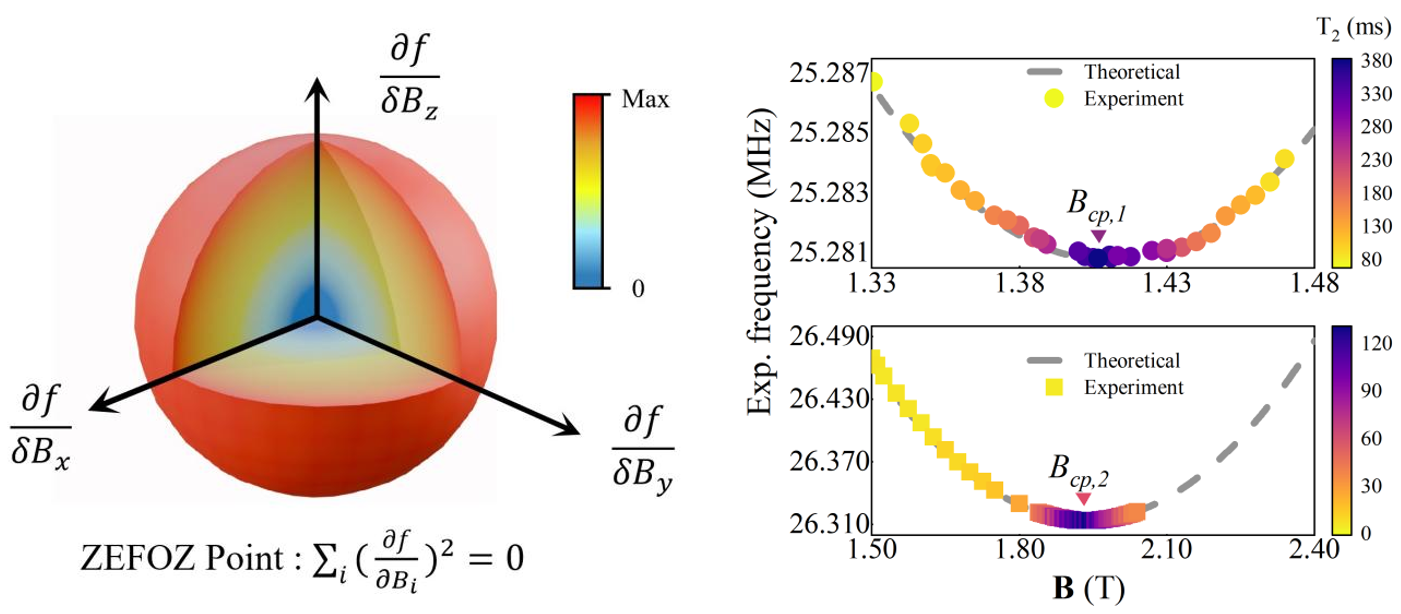
Figure 1 | Schematic and experimental characterization of ZEFOZ operating points. The left panel illustrates the ZEFOZ condition, where the first-order derivatives of the nuclear-spin transition frequency with respect to all three magnetic-field components vanish. The right panel shows the magnetic-field dependence of two nuclear-spin transition frequencies of 151Eu, with the color of each data point indicating the corresponding nuclear-spin coherence time. Near the ZEFOZ point, the coherence time is significantly extended, reaching a maximum of 372 ms.
Building on this result, the team applied CPMG dynamical decoupling, using a sequence of radio-frequency pulses to suppress the effects of environmental noise on nuclear spin coherence. This extended the coherence time to approximately 15 seconds, an improvement of about four orders of magnitude over the zero-field value. These results show that magnetic-field control and dynamical decoupling can enable long-lived nuclear spin coherence even in stoichiometric crystals densely populated with rare-earth ions, providing a new material platform and experimental basis for developing solid-state quantum memories that combine high optical depth with long spin coherence lifetimes.
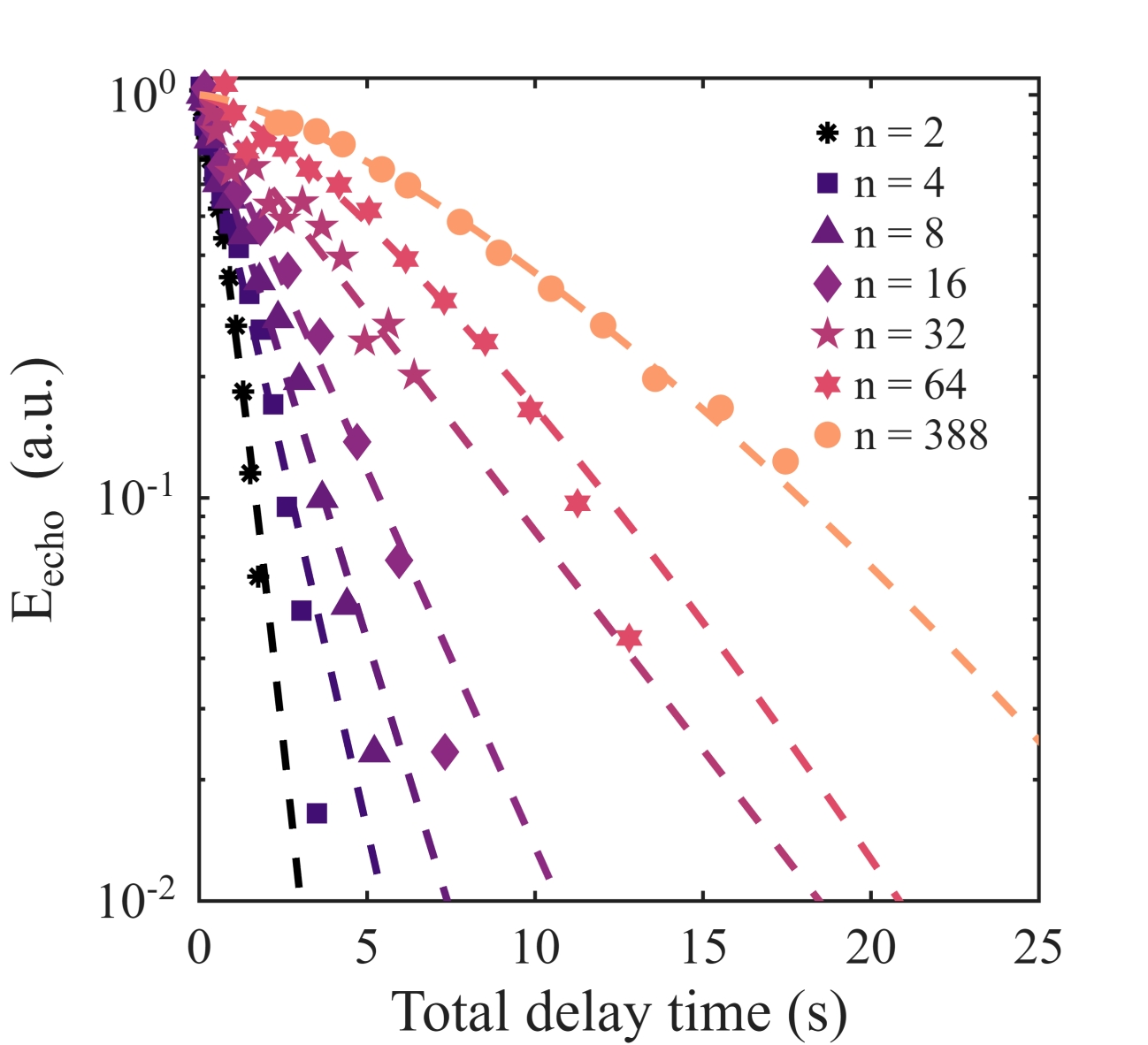
Figure 2 | Long-lived nuclear spin coherence enabled by CPMG dynamical decoupling. Nuclear spin echo decay curves measured with different numbers of decoupling pulses. The echo decay becomes markedly slower as the number of pulses increases.
The team also investigated how Er3+ doping affects the local magnetic environment in stoichiometric EuCl3·6H2O crystals. Er3+ has optical transitions in the telecom band, while Eu3+ offers long-lived nuclear spin coherence, giving the two ions complementary advantages for constructing quantum network nodes. The researchers found that, after introducing a small amount of Er3+ into the stoichiometric crystal, neighboring Eu3+ nuclear spins could still retain coherence for up to approximately 50 milliseconds. These findings provide experimental support for a quantum network node scheme recently proposed by the team, in which Er3+ serves as a telecom interface and neighboring Eu3+ nuclear spins form local quantum registers [1]. These results bring the proposed scheme a step closer to realizing quantum network nodes that combine telecom interfaces with long-lived quantum storage.
In this work, Ph.D. student Mucheng Guo and M.Sc. Student Zhehao Xu are co-first authors. The corresponding authors are Associate Researchers Fudong Wang and Shuping Liu and Researcher Manjin Zhong, all at the Shenzhen International Quantum Academy. Professors Matthew J. Sellars and Rose L. Ahlefeldt at the Australian National University also made important contributions to the work. This work was supported by the National Natural Science Foundation of China, Hefei National Laboratory, the Department of Science and Technology of Guangdong Province, and the Shenzhen Science and Technology Commission, and other institutions.
Paper link: https://doi.org/10.1103/hk6v-6bp3
[1] Guo, M., Xiao, W., Li, Z. et al. Towards telecom-compatible quantum nodes using erbium-doped stoichiometric EuCl3·6H2O crystals. npj Quantum Inf 12, 57 (2026).