
中文
中文
Recently, researchers from the Shenzhen International Quantum Academy (IQASZ), Peking University, and Nankai University have made significant progress in the estimation of quantum properties of symmetric states. The research team proposed a compact measurement scheme that exploits the symmetry of quantum states, enabling a substantial improvement in the estimation efficiency of both linear and nonlinear properties of symmetric states. The team further prepared three- and four-qubit GHZ states and W states on a photonic quantum platform, and experimentally measured random Hamiltonians, spin Hamiltonians, and nonlinear functions. The results show that, under the same measurement resources, the proposed method achieves higher estimation accuracy. This work, entitled "Symmetry Speeds up Quantum Measurements", was published on September 15, 2026, in Physical Review Letters.
Estimating the linear and nonlinear properties of quantum states is a fundamental task in quantum information science, typically requiring the preparation and measurement of a large number of state copies. In recent years, the classical shadow (CS) method, by combining randomized measurements with classical post-processing, has enabled efficient estimation of the expectation values of many observables, significantly reducing the required measurement resources. Building on this, a variety of randomized measurement protocols based on Pauli measurements have been further developed, continuously improving estimation efficiency by optimizing the choice of measurement bases and the allocation of resources for specific Hamiltonians. However, existing methods generally do not fully exploit the prior structural information inherent in quantum states, such as symmetry. As a central concept in physics, symmetry is not only closely related to fundamental conservation laws, but has also gradually become an important tool for optimizing quantum information processing and reducing quantum resource overhead.
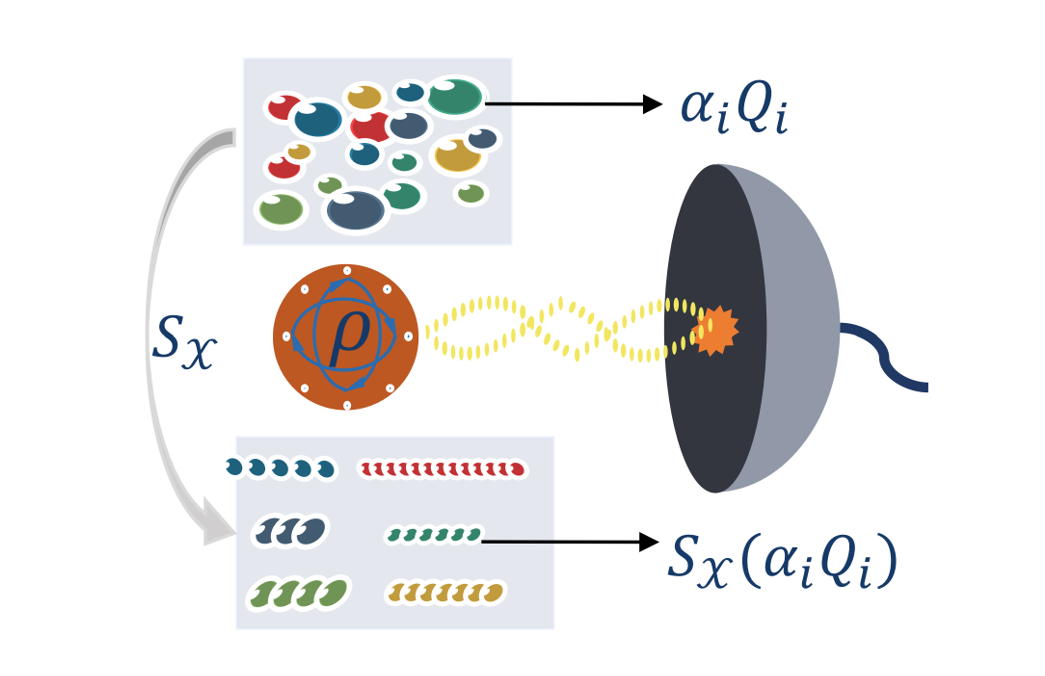
Figure 1: Schematic illustration of the compact measurement scheme
To address this issue, the research team proposed a compact measurement scheme tailored for symmetric quantum states. Its core idea is to transfer the symmetry of the quantum state to the observable being measured, thereby symmetrizing and reorganizing the Pauli terms without changing the target expectation value, so as to reduce redundant measurement contributions. The scheme preserves the basic structure of Pauli-basis measurements and can be combined with existing Pauli measurement methods. Theoretical analysis shows that for any fixed Pauli-basis measurement protocol, a compatible symmetrization scheme can be constructed such that the estimator variance is no greater than that of the original protocol; for specific observables, further adopting compact grouping can significantly reduce the number of required state copies, achieving polynomial or even exponential improvements in sample complexity in some cases.
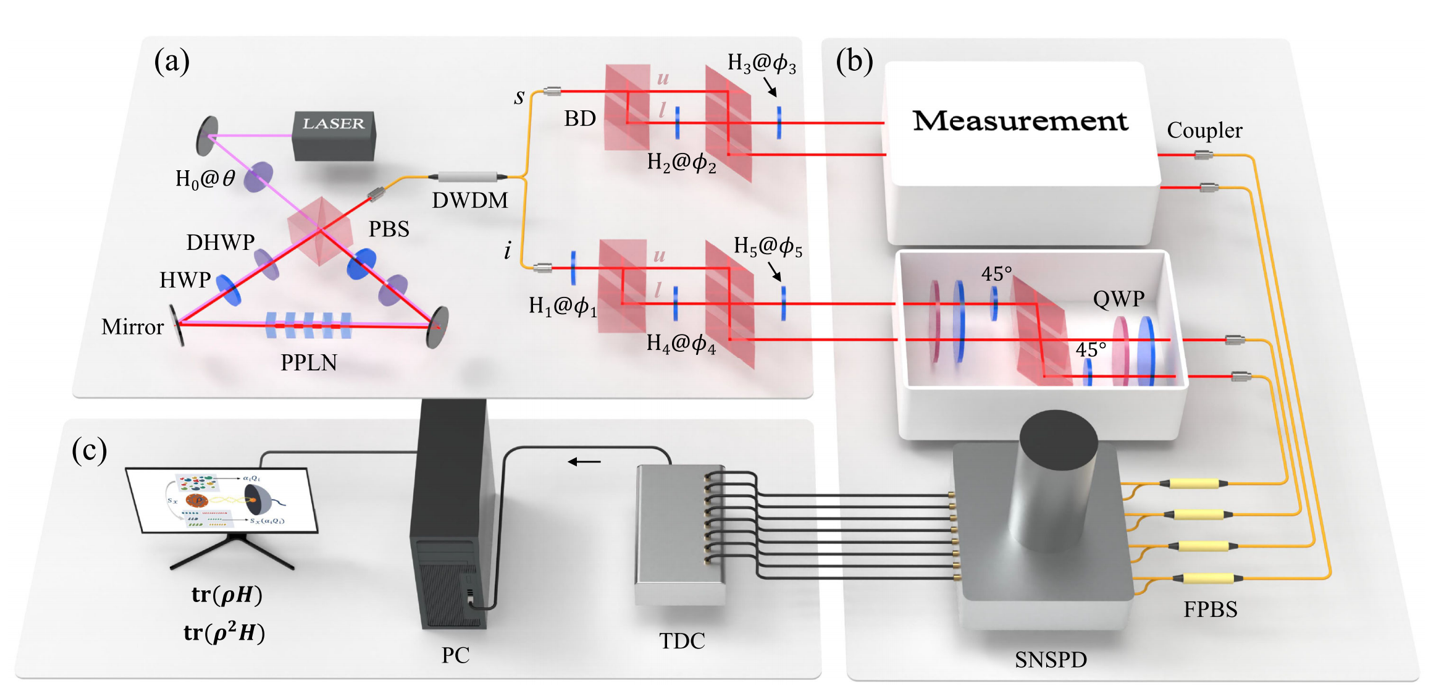
Figure 2: Photonic quantum experimental platform, comprising symmetric-state preparation, Pauli measurement, and data-processing modules
Furthermore, the research team prepared three- and four-qubit GHZ states and W states on a photonic quantum platform, and systematically verified the linear and nonlinear properties of the quantum states. In the estimation of linear properties, the team examined a random three-qubit Hamiltonian and a four-qubit spin Hamiltonian, respectively, and compared the scheme with representative methods such as shadow grouping (SG), derandomized classical shadows (Derand), overlapped grouping (OGM), and the adaptive Pauli scheme (AP); in the estimation of nonlinear properties, the team further verified the efficient estimation of Tr(ρ2H). The experimental results show that, under the same measurement cost, the compact measurement scheme achieves higher estimation accuracy, confirming the practical feasibility of exploiting quantum-state symmetry to reduce measurement overhead.
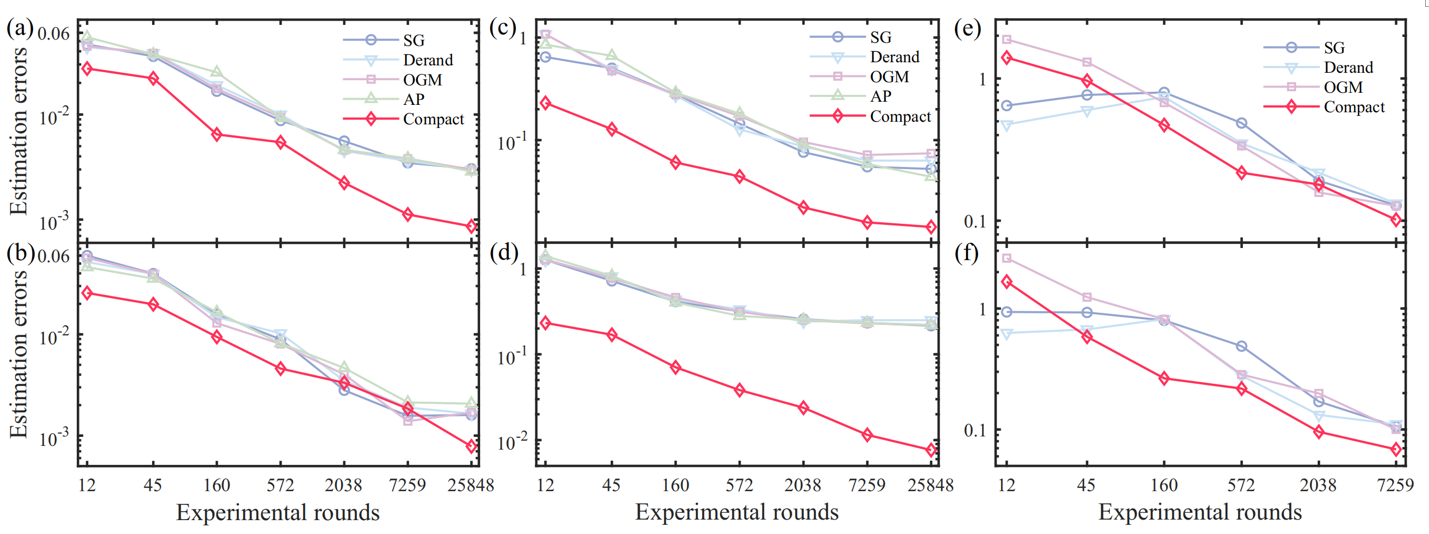
Figure 3: Comparison of estimation errors among different measurement schemes
Hu Chen (IQASZ/SUSTech) and Bujiao Wu (IQASZ) are co-first authors. The corresponding authors are Xiao Yuan (Peking University) and Zheng-Da Li (IQASZ). The research was supported by the Quantum Science and Technology-National Science and Technology Major Project, the National Natural Science Foundation of China, the Guangdong Basic and Applied Basic Research Foundation, the Beijing Natural Science Foundation, and other funding programs.
Paper Link : https://link.aps.org/doi/10.1103/q9lf-cp11