
中文
中文
【Research Highlights】
Recently, Prof. Masahito Hayashi (Lin Zhengren), jointly appointed at the School of Data Science of The Chinese University of Hong Kong, Shenzhen, and the Shenzhen International Quantum Academy, together with Wang Wusheng, a Ph.D. student from the Graduate School of Mathematics at Nagoya University, proposed a new framework for quantum message authentication—Verifier-Initiated Quantum Digital Signatures (VIQDS). By leveraging quantum zero-knowledge proof techniques, they constructed a quantum message authentication protocol that supports on-demand verification and achieves information-theoretic security.The research results were published in the international academic journal Nature Communications under the title:“Verifier-initiated quantum message-authentication via quantum zero-knowledge proofs.”
【Overview】
Digital signatures are a fundamental tool in modern information security systems, widely used to guarantee data integrity, authenticity, and non-repudiation. In the classical internet, digital signatures underpin applications such as electronic contracts, identity authentication, blockchain transactions, and secure login systems.
With the development of quantum communication, quantum networks, and quantum computing technologies, how to achieve secure, efficient, and scalable message authentication in the quantum era has become a critical research topic in quantum cryptography.
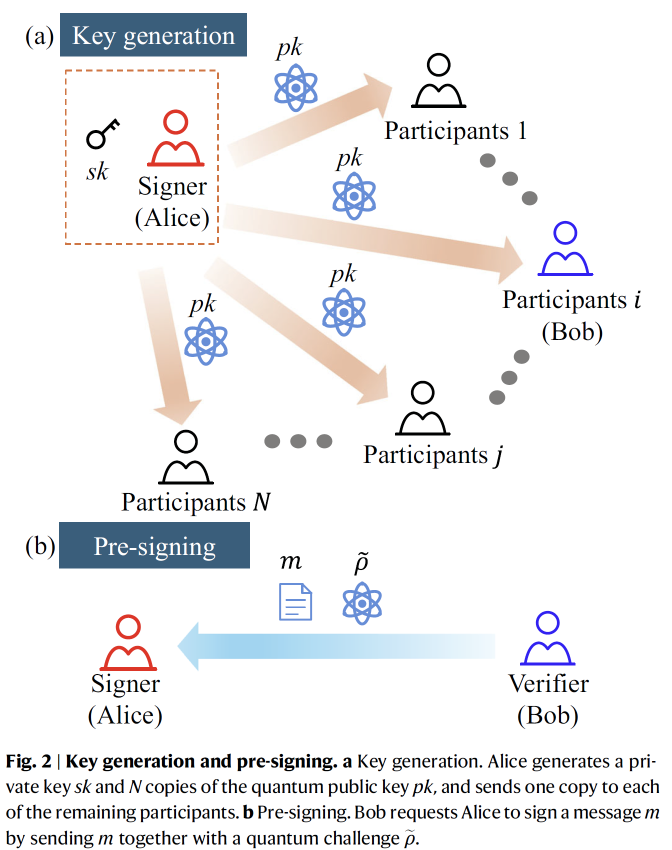
Most existing quantum digital signature schemes follow a “signer-initiated” paradigm: the signer must generate and distribute quantum or classical authentication materials in advance for future message verification. However, in practical systems, verification often occurs sporadically and on demand. For example, in large-scale distributed networks, blockchain systems, or auditing scenarios, a particular message may never be verified. Pre-distributing authentication materials for all potential verification needs leads to unnecessary communication, storage, and computational overhead. To address this issue, Prof. Hayashi and collaborators introduced the concept of Verifier-Initiated Quantum Digital Signatures (VIQDS). In this paradigm, the verifier initiates the authentication process only when needed, making quantum message authentication more compatible with the operational requirements of future quantum networks and distributed systems.
To realize this idea, the work incorporates the concept of Quantum Zero-Knowledge Proofs (QZKPs). Zero-knowledge proofs allow a prover to convince a verifier that a statement is true without revealing any additional information beyond its validity. Within this framework, the signer plays the role of the prover in zero-knowledge protocols, while the verifier retains its role as the verifier. The signing key naturally corresponds to the secret knowledge in the proof system, and the message itself is treated as the statement to be proven. Through this role mapping, the authors establish a general compilation framework that systematically transforms quantum zero-knowledge proof protocols into VIQDS schemes.
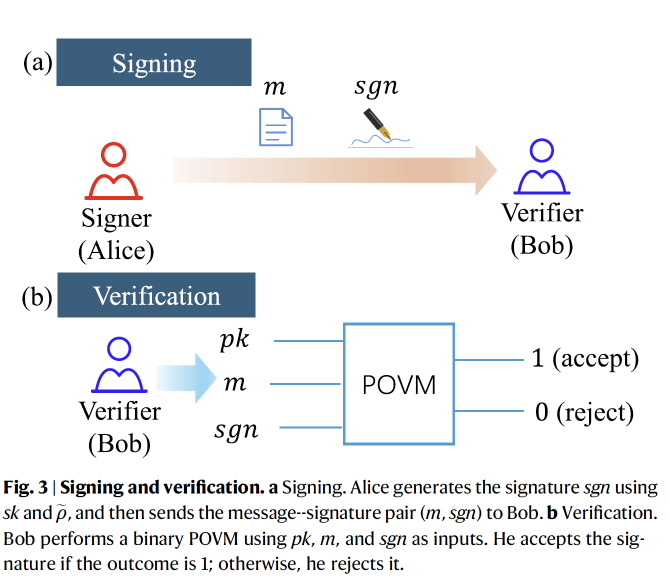
On the security side, this work further advances the theoretical framework of quantum zero-knowledge proofs by extending it to handle dishonest provers and by explicitly considering specious verifiers, that is, verifiers who appear honest while attempting to extract additional information. In addition, the authors provide explicit constructions of secure protocols and introduce a general method for exponentially amplifying the soundness of quantum zero-knowledge proof protocols.
This work fills a theoretical gap in quantum message authentication by introducing the verifier-initiated paradigm and establishes a systematic connection between quantum zero-knowledge proofs and quantum digital signatures. The proposed protocols simultaneously achieve information-theoretic security, scalability, and experimental feasibility, making them strong candidates for practical deployment. These results are expected to serve as a foundational framework for secure authentication systems in the post-quantum era and in future quantum network infrastructures.
【Publication Information】
This research was supported by the National Natural Science Foundation of China, The Chinese University of Hong Kong, The Chinese University of Hong Kong (Shenzhen), and the Guangdong Provincial Department of Science and Technology.
Paper Links:https://arxiv.org/abs/2512.05420
DOI: 10.1038/s41467-026-74620-w