
中文
中文
Recently, under the leadership of Academician Dapeng Yu, the research team led by Researcher Yuan Xu at the Shenzhen International Quantum Academy has made a major breakthrough in the generation of continuous variable Non-Gaussian quantum resources. By employing a programmable parameterized quantum circuit, the research team successfully generated non Gaussian states—including tri squeezed, quad squeezed, and cubic phase states—within a superconducting microwave cavity. This work provides essential resources for continuous variable quantum computation and quantum metrology. The results have been published in the prestigious international optics journal Optica, titled “Generating and characterizing generalized squeezed states in a superconducting microwave cavity.”
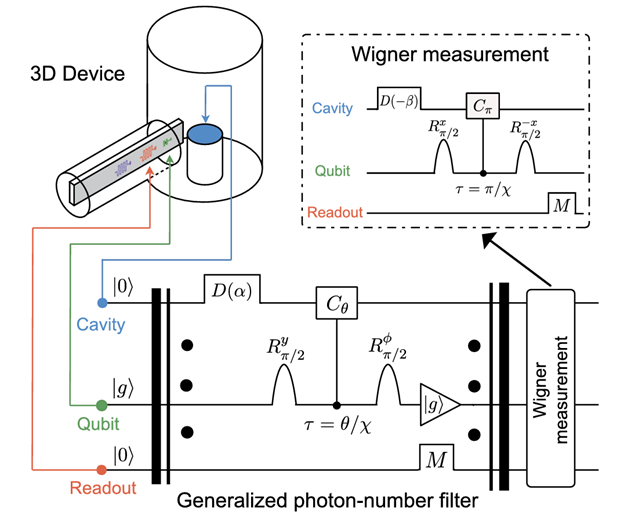
Figure 1: Experimental setup and circuit diagram of the parametrized photon number filter operations for non Gaussian state preparation.
The experimental preparation of non Gaussian states usually relies on precise engineering of high order nonlinear interactions, which is experimentally challenging. To address this challenge, the research team develops and implements a parametrized photon number filter (PNF) operation by utilizing the dispersive coupling between a superconducting microwave cavity and an auxiliary qubit in a 3D circuit quantum electrodynamics architecture. This operation performs photon number dependent filtering on the cavity state. By numerically optimizing the key parameters of the PNF operation (including displacement amplitude and phase, conditional phase, and the rotation axis of the auxiliary qubit) and cascading multiple PNF operations, the team successfully prepared tri squeezed, quad squeezed, and cubic phase states with high fidelity inside the superconducting microwave resonator.
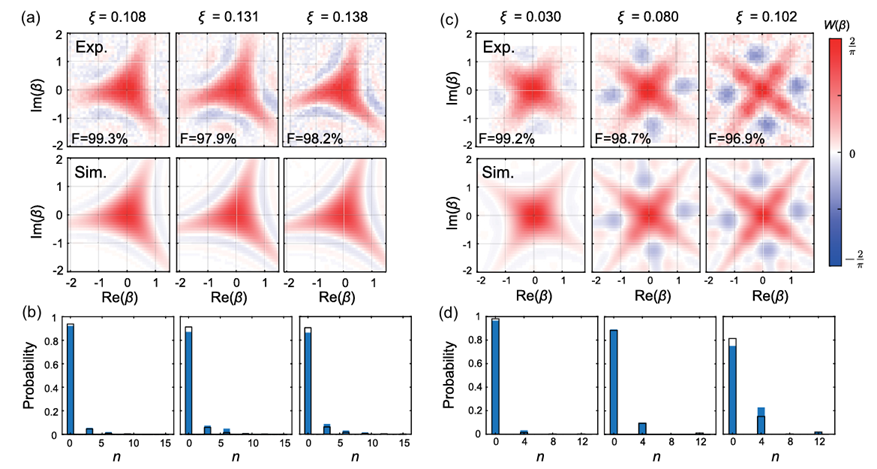
Figure 2: Experimental prepared tri squeezed and quad squeezed states.
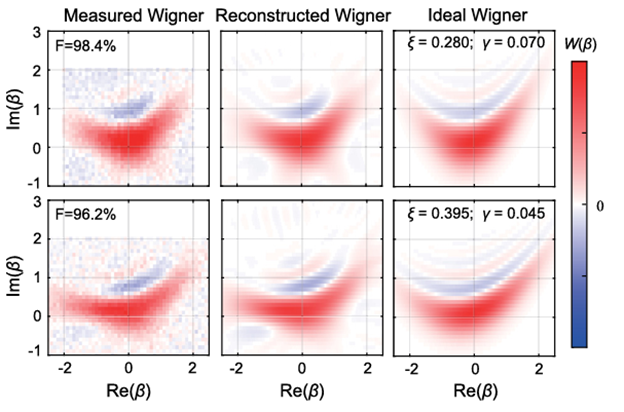
Figure 3: Experimental prepared cubic phase states.
To quantitatively evaluate the non Gaussian character of the prepared quantum states, the research team calculates the Wigner logarithmic negativity of the prepared higher-order squeeze state. The extracted Wigner logarithmic negativity show that as the squeezing order and squeezing parameter increase, the Wigner negativity clearly grows, contrasting with the Gaussian nature of conventional two photon squeezed states. Furthermore, by calculating the quantum Fisher information, the team demonstrated the significant potential of these non Gaussian resources for quantum metrology.
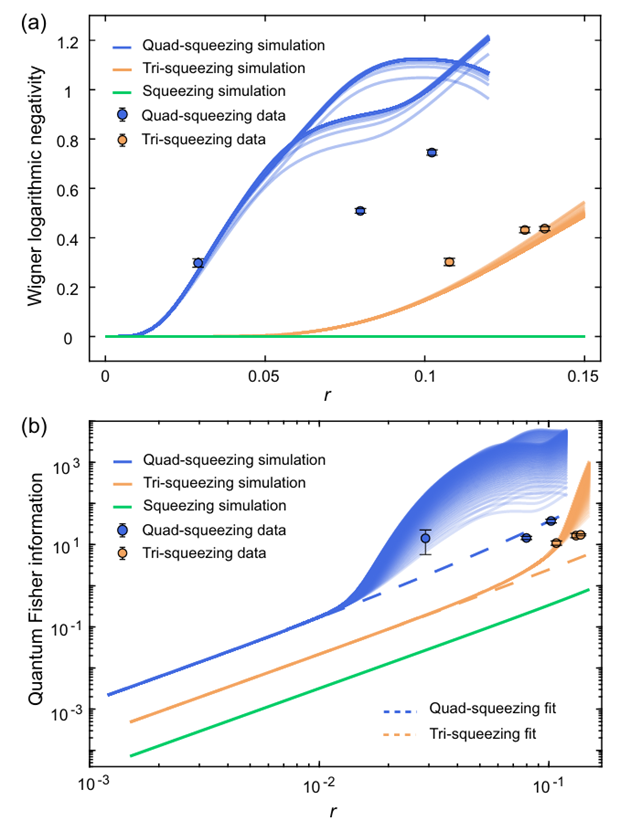
Figure 4: Wigner logarithmic negativity and quantum Fisher information of the high order squeezed states.
In this study, associate researcher Xiaowei Deng and Ph.D. student Yanyan Cai from Shenzhen International Quantum Academy contributed equally as co first authors. Researcher Yuan Xu from the Shenzhen International Quantum Academy is the corresponding authors, and academician Dapeng Yu is the senior author. Other co authors include associate researcher Zhongchu Ni, Ph.D. student Libo Zhang, and professor Song Liu. The Shenzhen International Quantum Academy is the primary affiliation for this research. The work was supported by the Department of Science and Technology of Guangdong Province, the Shenzhen Science and Technology Innovation Commission, the National Natural Science Foundation of China, the Hefei National Laboratory, and other institutions.
Paper Links:https://doi.org/10.1364/OPTICA.596662