
中文
中文
Under the leadership of Academician Dapeng Yu, the superconducting quantum team at the Shenzhen International Quantum Academy (SIQA) has collaborated with Researcher Zhi-Cheng Yang's group at Peking University and Prof. Xiao Chen's group at Boston College to experimentally observe two measurement- and feedback-driven nonequilibrium phase transitions on the same programmable multi-qubit superconducting quantum processor: an absorbing-state transition at the level of the quantum channel and a measurement-induced entanglement transition at the level of individual quantum trajectories. The related work, entitled "Measurement- and Feedback-Driven Nonequilibrium Phase Transitions on a Quantum Processor," was published online in Physical Review Letters on June 29, 2026.
Mid-circuit measurements and conditional feedback are essential capabilities for quantum error correction, fault-tolerant quantum computing, and dynamic quantum circuits. In many-body quantum dynamics, measurements are not merely passive readout operations: each measurement reshapes the quantum state, and feedback conditioned on the measurement outcome further turns the evolution into an adaptive closed loop of measurement, decision, and control.
Such adaptive quantum circuits provide a new route for exploring nonequilibrium quantum many-body physics. Interleaving unitary evolution, stochastic measurements, and real-time feedback can generate phase transitions at different dynamical levels, including absorbing-state transitions in the averaged quantum channel and measurement-induced entanglement transitions in individual quantum trajectories. Experimentally resolving both transitions on real hardware requires a sufficiently large qubit system, high-fidelity gate and readout operations, and low-latency real-time feedback.
In this study, the experiment was carried out on a two-dimensional superconducting quantum processor developed by the SIQA superconducting team. The chip integrates 66 frequency-tunable transmon qubits and 110 tunable couplers, from which 30 qubits were selected to form a one-dimensional ring. The adaptive circuit consists of alternating layers of iSWAP-like entangling gates, local single-qubit rotations, probabilistic mid-circuit measurements, and real-time conditional feedback.
The platform achieved typical single-qubit gate fidelities of about 99.9%, iSWAP-like two-qubit entangling-gate fidelities of about 99.3%, and a global mid-circuit quantum non-demolition (QND) readout fidelity of about 98.7%. With an FPGA-based real-time controller, the conditional decision latency was reduced to about 200 ns. These capabilities in multi-qubit chips, high-fidelity gate operations, low-latency control electronics, and real-time feedback were the key foundation for realizing the experiment at this scale.
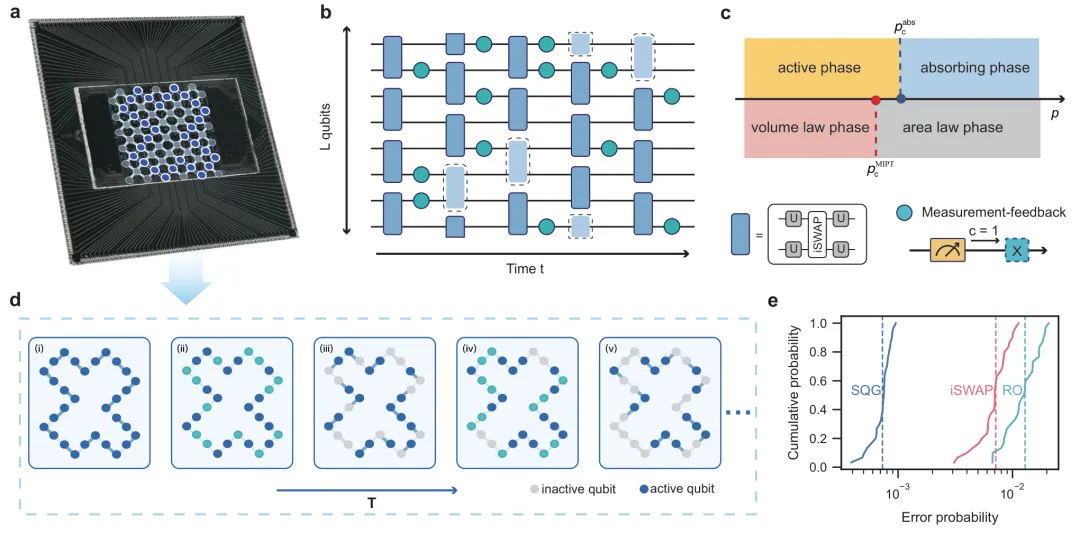
Figure 1. Superconducting quantum processor, adaptive quantum circuit, and device performance for measurement-feedback dynamics.
By tuning the measurement-feedback probability p, the team observed a transition from an active phase to an absorbing phase in the 30-qubit ring. When measurement feedback is weak, local excitations can spread through the chip and maintain finite activity. When measurement feedback is sufficiently strong, excitations are rapidly removed and the system is driven into the particle-free absorbing state. The absorbing-state critical point was identified around p ≈ 0.35, with dynamical critical behavior consistent with the one-dimensional directed percolation universality class.
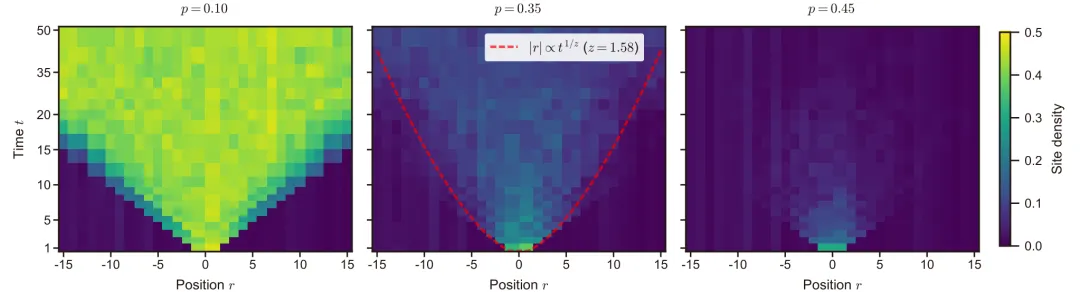
Figure 2. Absorbing-state transition dynamics in a 30-qubit system under different measurement-feedback probabilities.
At the same time, measurements can reshape quantum entanglement. On the same processor, the team implemented an eight-qubit version of the adaptive circuit and used trajectory-resolved quantum-state tomography to extract Renyi entanglement entropy and its fluctuations. The variance of the entanglement entropy develops a peak near p ≈ 0.20, marking the measurement-induced entanglement transition.
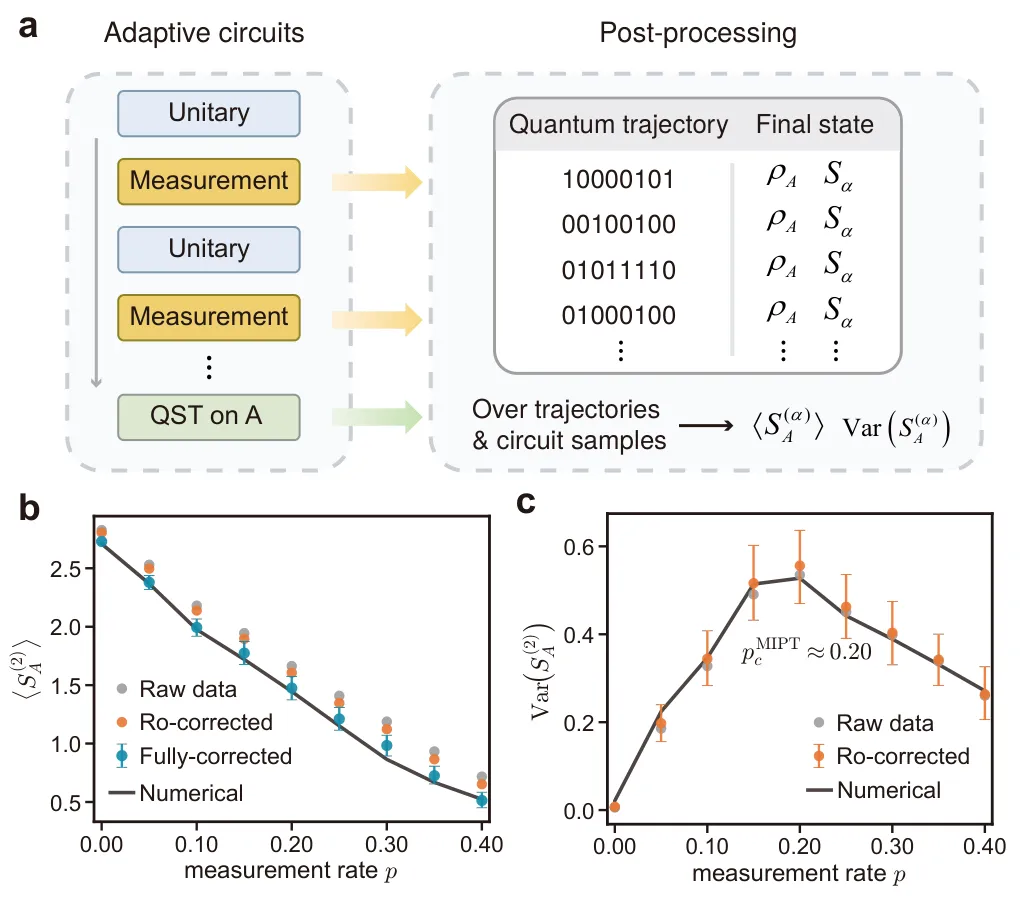
Figure 3. Measurement-induced entanglement transition at the trajectory level and characterization using the second Renyi entanglement entropy.
Notably, the critical point of the entanglement transition is lower than that of the absorbing-state transition, indicating that the quantum information structure changes before the macroscopic particle-number dynamics undergoes a phase transition. This result directly demonstrates on quantum hardware the separation between measurement-induced entanglement transitions and feedback-driven absorbing-state transitions, providing experimental evidence for understanding information flow, feedback control, and nonequilibrium criticality in adaptive quantum dynamics.
This study demonstrates the capability of SIQA's programmable superconducting quantum processor to extend from static quantum-circuit execution to dynamic adaptive quantum-circuit execution. Looking ahead, as processor size, gate fidelity, and real-time control capabilities continue to improve, this platform is expected to enable quantum simulations of larger systems, higher-dimensional geometries, and more complex feedback protocols, while also providing key experimental support for active quantum error correction and adaptive quantum algorithms.
All experimental work in this study was enabled by the long-term and substantial expertise accumulated by the SIQA superconducting quantum team in multi-qubit superconducting quantum chips, high-fidelity quantum gate operations, low-latency control electronics, and real-time feedback experiments. The theoretical modeling, numerical simulations, and analysis of the physical mechanisms benefited from systematic work by Researcher Zhi-Cheng Yang's group at Peking University and Prof. Xiao Chen's group at Boston College. The first author of the paper is Zhiyi Wu, a doctoral student supervised by Academician Dapeng Yu at the School of Physics, Peking University, and a visiting student at SIQA. SIQA Researcher Jingjing Niu, Associate Researcher Ji Chu, and graduate students Xuandong Sun and Jiawei Zhang also participated in the work. The principal corresponding authors include Prof. Xiao Chen of Boston College and Researcher Zhi-Cheng Yang of Peking University, among others. Academician Dapeng Yu is the last author of the paper.
Paper Links : https://journals.aps.org/prl/abstract/10.1103/2c1p-8vx9
DOI: 10.1103/2c1p-8vx9