
中文
中文
In disordered or quasiperiodic quantum systems, microscopic particles such as electrons may exhibit three distinct types of quantum states: extended states, which spread across the entire system; localized states, which are confined within a finite region; and critical states, which lie between these two limits. Critical states possess self-similar multifractal structures and are the most intriguing, yet also the most difficult to identify rigorously. In finite-size experimental systems, extended and localized states may display similar features, making the precise identification of critical states a long-standing challenge.
Recently, Superconducting Quantum Computing team of SZIQA, together with the team of Prof. Xiong-Jun Liu from the Center for Quantum Materials Science, School of Physics, Peking University, experimentally observed and characterized exact quantum critical states for the first time using programmable superconducting qubits. By realizing a quasiperiodic mosaic model, the team revealed the universal mechanism underlying these states—namely, incommensurately distributed zeros—and observed an anomalous mobility edge separating critical and localized states.
This breakthrough builds on a series of theoretical works by Prof. Liu’s group in recent years. The team previously proposed a quasiperiodic mosaic model with exact mobility edges, uncovered the universal mechanism by which incommensurately distributed zeros induce critical states, and further established a unified theoretical framework for describing fundamental localization phases. These theoretical results were published in journals including Physical Review Letters and Science Bulletin. However, the rigorous identification of critical states and the experimental observation of anomalous mobility edges had remained unrealized.
In the present study, the researchers employed a two-dimensional superconducting quantum processor integrating 66 frequency-tunable superconducting qubits and 110 tunable couplers. By selecting a one-dimensional chain of qubits and independently controlling nearest-neighbor couplings and onsite potentials, they constructed a programmable quasiperiodic mosaic model.
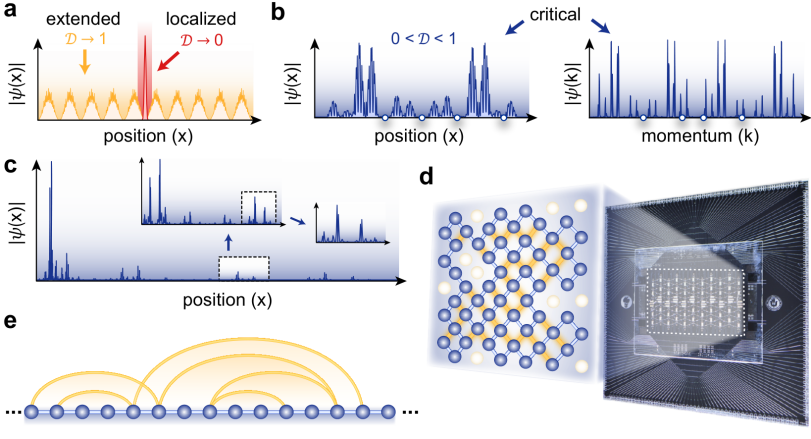
Figure 1. Schematic illustration of the mechanism for quantum critical states and the superconducting-qubit platform.
Using this platform, the team measured the time-resolved density distribution and observed a hallmark dynamical signature of critical states: near an incommensurately distributed zero, the wave packet propagates predominantly along one side of the zero while showing almost no propagation on the other side.
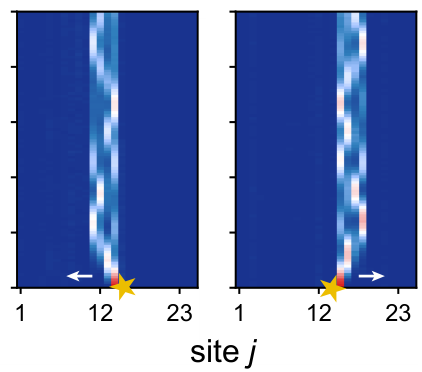
Figure 2. One-sided propagation of a wave packet near an incommensurately distributed zero in the critical phase.
The team further extended this mechanism to systems with long-range couplings and found that the critical states remain robust against weak long-range coupling. As long as the incommensurately distributed zeros are preserved, the critical states remain stable. When the long-range coupling exceeds a threshold and eliminates these zeros, the system undergoes a transition from the critical phase to an extended phase. The criteria obtained from renormalization-group analysis and numerical calculations agree well with the experimental results, providing further evidence that incommensurately distributed zeros constitute the key mechanism stabilizing quantum critical states.
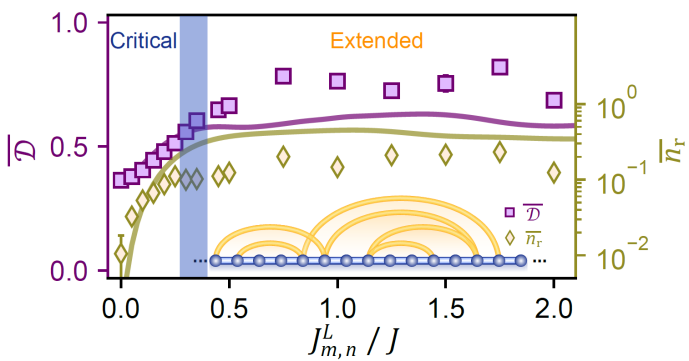
Figure 3. The localized–critical phase transition and its breakdown under long-range coupling.
This work realizes the first experimental observation and characterization of exact quantum critical states, and provides a standard methodology for detecting critical states across a broad range of quantum simulation platforms.
The results, entitled “Observation of exact quantum critical states,” were published online in Nature Physics on June 9, 2026.
The co-first authors of the paper are Wenhui Huang, a doctoral student at Southern University of Science and Technology; Xin-Chi Zhou, a doctoral student at the International Center for Quantum Materials, School of Physics, Peking University, now a postdoctoral researcher at the Max Planck Institute for the Physics of Complex Systems; Libo Zhang and Jiawei Zhang, doctoral students at Southern University of Science and Technology; Yuxuan Zhou, an assistant researcher at the Shenzhen Institute for Quantum Science and Engineering; and Bingchen Yao, an undergraduate student at the School of Physics, Peking University. The corresponding authors are Prof. Xiong-Jun Liu, Academician Dapeng Yu, Prof. Youpeng Zhong, Assistant Prof. Ziyu Tao, and Prof. Song Liu.
This research was supported by the National Key R&D Program of China, the National Science and Technology Major Project on Quantum Communication and Quantum Computing, the National Natural Science Foundation of China, the Shenzhen Science and Technology Innovation Commission, the Shanghai Municipal Science and Technology Major Project, and the Xplorer Prize from the New Cornerstone Science Foundation.
Paper link:
https://www.nature.com/articles/s41567-026-03333-0
DOI: 10.1038/s41567-026-03333-0