
中文
中文
Recently, the research group led by Researcher Zheng-Da Li at the Shenzhen International Quantum Academy (IQASZ), together with collaborators, has made significant progress in the study of genuine multipartite quantum nonlocality. The research team extended Gisin’s theorem to arbitrary multipartite systems and, for the first time within a multicopy network framework, proved that the genuine multipartite entanglement of all pure states is equivalent to the genuine multipartite nonlocality. With this scheme, experimentally, the research team successfully demonstrated genuine quantum nonlocality in a tripartite entangled system within parameter regions where the traditional Svetlichny inequality fails to detect genuine quantum nonlocality. This work, entitled "Testing Genuine Multipartite Nonlocality via an Inflated Network with Multicopy Entangled States", was published on June 5, 2026, in Physical Review Letters.
Quantum entanglement, quantum steering, and quantum nonlocality are three types of quantum correlations that exhibit a strict hierarchical relationship. In general, quantum nonlocality implies steering, and steering implies entanglement, while the converse relationships do not generally hold. In 1991, Gisin proved that any pure entangled state in a bipartite quantum system exhibits quantum nonlocality. This theorem represents a milestone in the study of quantum correlations, revealing the equivalence of entanglement and nonlocality for bipartite pure states. However, extending Gisin’s theorem to general multipartite quantum systems is still an open and fundamental problem in quantum information science.
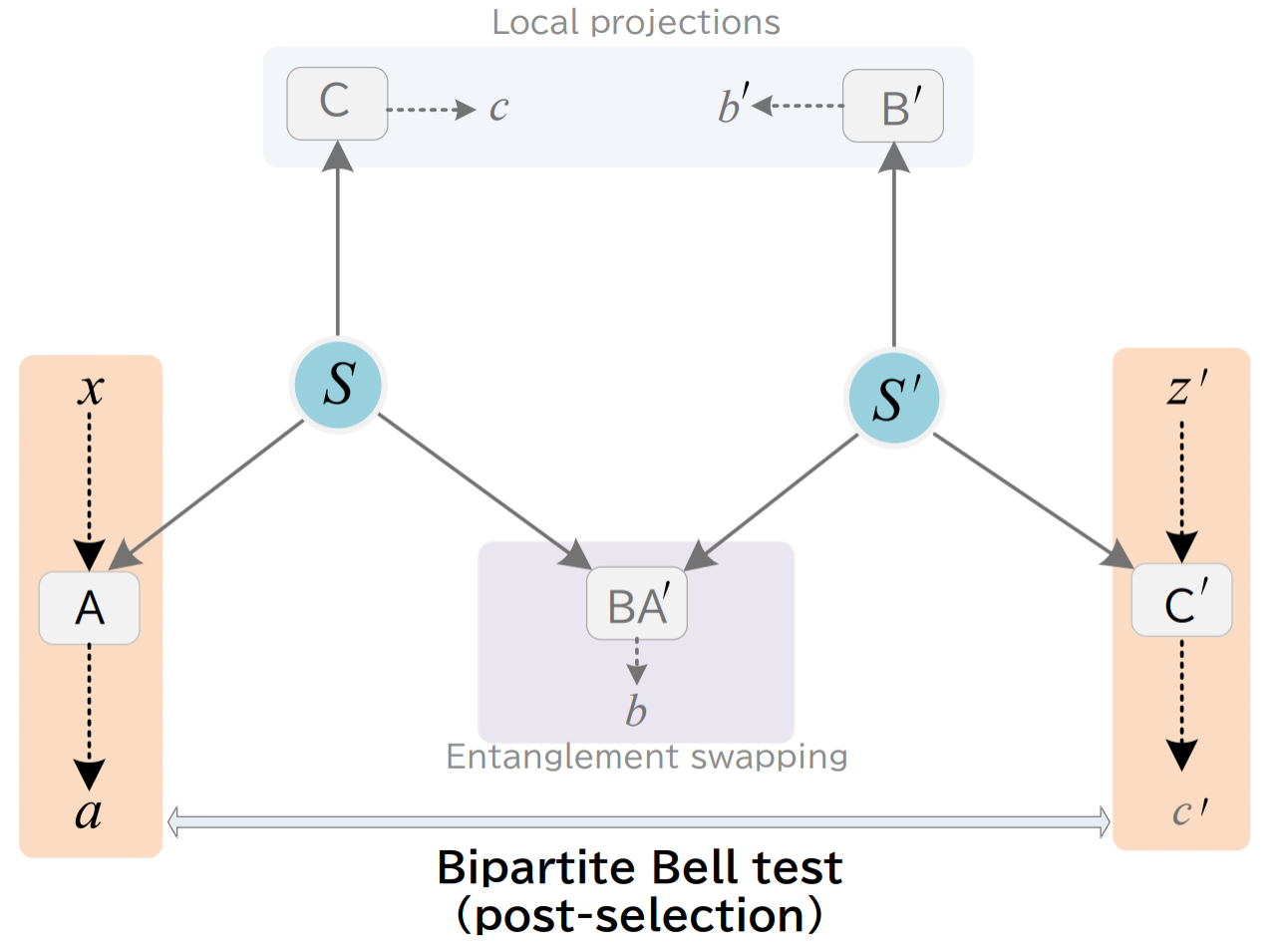
Figure 1: Asymmetric two-copy five-partite quantum network
The research team constructed an inflated network based on multicopy entangled states, extending Gisin’s theorem to arbitrary multipartite quantum systems. For the first time in the multicopy framework, they proved that for all pure states, genuine multipartite entanglement, genuine multipartite quantum steering, and genuine multipartite quantum nonlocality are equivalent, thus giving a fundamental understanding of this long-standing fundamental problem.
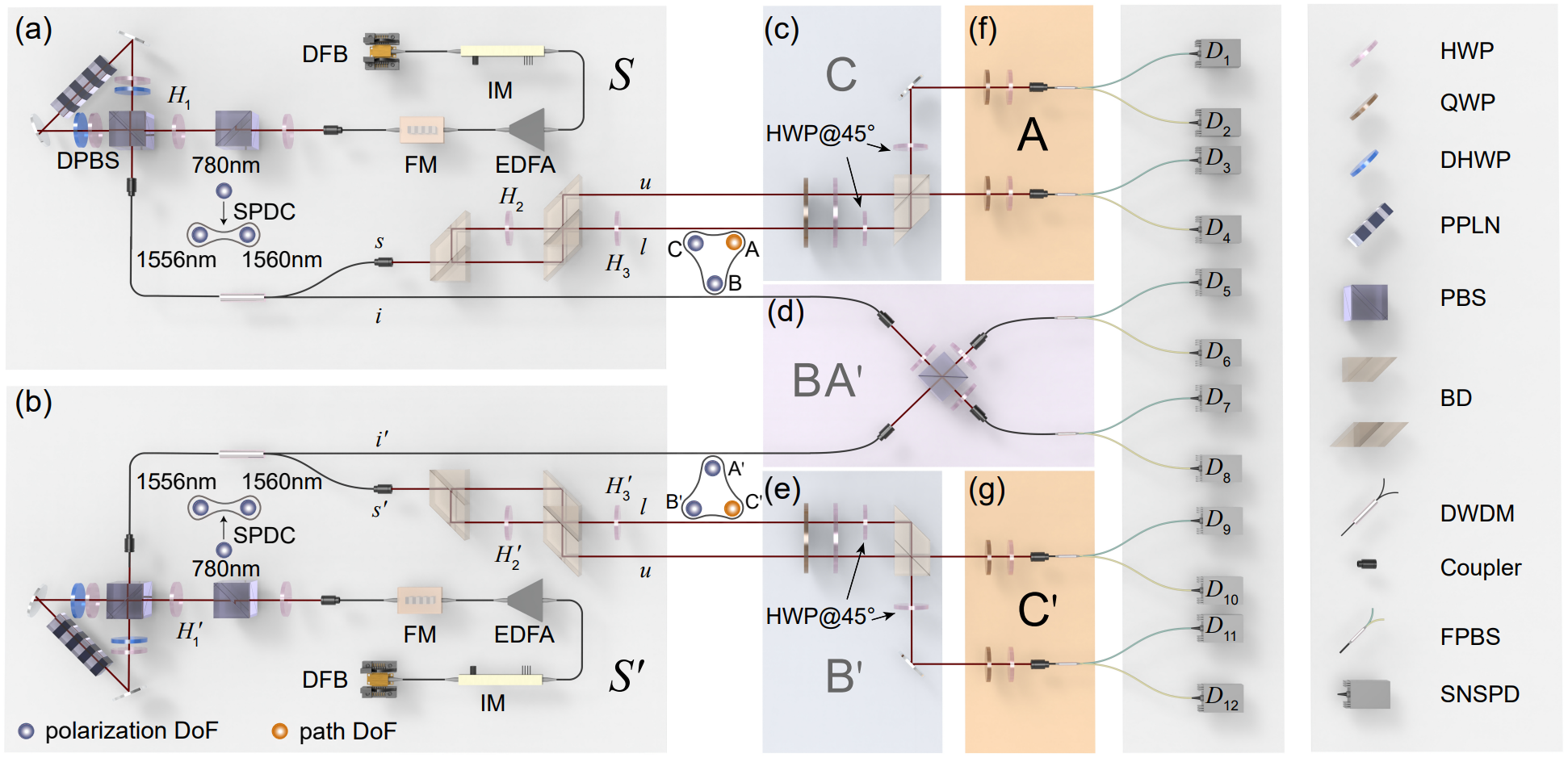
Figure 2: Experimental setup
Experimentally, using a photonic quantum network platform, the team successfully prepared two typical types of tripartite entangled states—GHZ-class states and W-class states encoded in both polarization and path degrees of freedom. They verified the genuine multipartite quantum nonlocality of these states within parameter regions where the traditional Svetlichny inequality fails.
This work, by utilizing distributed multicopy quantum states and various network topologies, opens a new path for exploring genuine nonlocality in multipartite systems and provides a solid theoretical foundation for building large-scale, highly secure quantum networks.
The Shenzhen International Quantum Academy (IQASZ) was the primary performing institution for this research. Qian-Xi Zhang (IQASZ/SUSTech PhD candidate) and Professor Ming-Xing Luo (Southwest Jiaotong University) are co-first authors. The corresponding authors are Professor Ya-Li Mao (Nankai University), Associate Professor Xue Yang (Southwest Jiaotong University), and Researcher Zheng-Da Li (IQASZ). Key collaborators include Professor Shao-Ming Fei (Capital Normal University). The research was supported by the Quantum Science and Technology-National Science and Technology Major Project, the National Natural Science Foundation of China, the Guangdong Basic and Applied Basic Research Foundation, the Shenzhen Fundamental Research Program, the Tianjin Natural Science Foundation Project, and other organizations.
Paper Link:
https://journals.aps.org/prl/abstract/10.1103/mwxx-ln9v