
中文
中文
Recently, a team led by Researcher Youpeng Zhong and Academician Dapeng Yu at the Shenzhen International Quantum Academy achieved a major breakthrough in superconducting quantum computation by realizing logical multi-qubit entanglement based on dual-rail encoding for the first time. The results, entitled “Logical multi-qubit entanglement with dual-rail superconducting qubits,” were published online in Nature Physics on March 6, 2026.
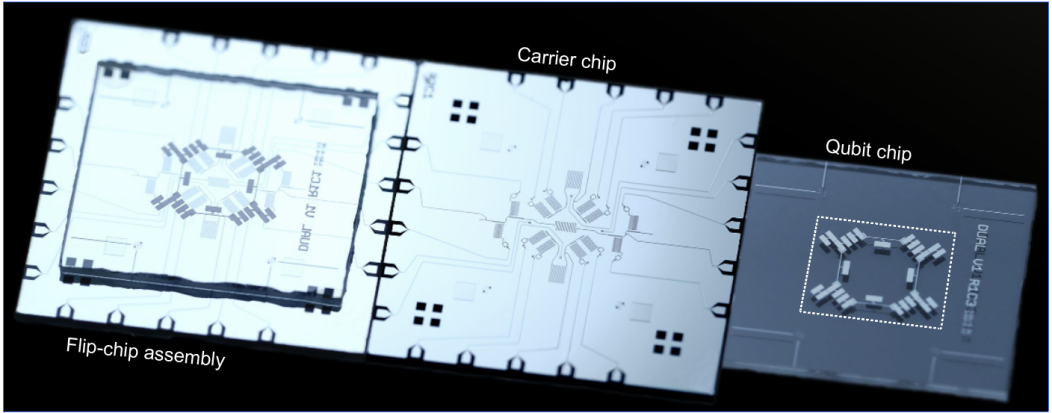
Dual-rail qubit chip
Quantum systems are inherently fragile: environmental noise leads to rapid loss of quantum information. How to process quantum information reliably and in a scalable manner in the presence of noise has therefore become a central obstacle that must be overcome for practical quantum computation. Quantum error correction is broadly considered the fundamental solution. Its core idea is to encode multiple physical qubits into a single logical qubit, using redundancy to actively detect and correct errors, thereby enabling exponential suppression of error rates in principle. In practice, however, conventional error-correction schemes typically require a large number of additional physical qubits and complex real-time feedback control. The resulting resource overhead has become a key bottleneck limiting scalability.
In recent years, erasure qubits have attracted significant attention as a hardware-efficient alternative. Unlike conventional qubits, erasure qubits can identify and label dominant error types directly at the hardware level, converting certain random errors into known, detectable events. This detectability substantially reduces the complexity of error correction and opens a new path toward more resource-efficient fault-tolerant quantum computation. In superconducting circuits, one important approach to realizing erasure qubits is dual-rail encoding. Previous studies have demonstrated its advantages in single-logical-qubit operations. However, extending this approach to high-fidelity logical entanglement and logical gate operations at the multi-qubit level has remained a central challenge.
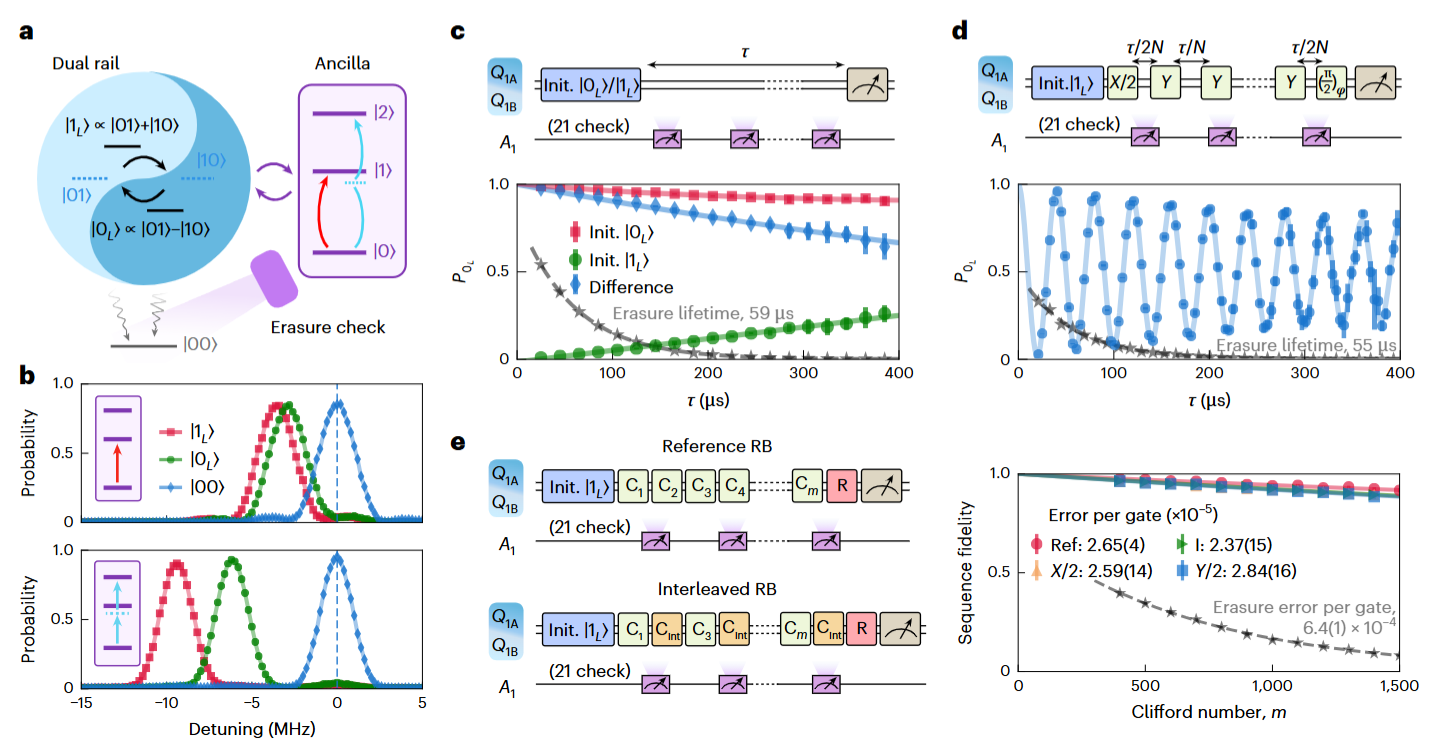
Figure 1. Erasure error detection, coherence characterization, and single-qubit gates randomized benchmarking for dual-rail logical qubits
In this work, the research team implemented a dual-rail superconducting qubit architecture on a scalable planar transmon chip and achieved high-fidelity logical multi-qubit entanglement for the first time. Each dual-rail logical qubit consists of a pair of tunable transmon qubits, with quantum information encoded in their single-excitation subspace. This design converts energy relaxation errors into detectable erasure errors. At the same time, the strong coupling between the two transmon qubits produces an effect analogous to passive dynamical decoupling, significantly suppressing dephasing noise. Experimentally, the logical qubits exhibit coherence times approaching 1 millisecond, more than an order of magnitude longer than those of the underlying physical qubits, and logical single-qubit gate errors are reduced to the 10-5 level.
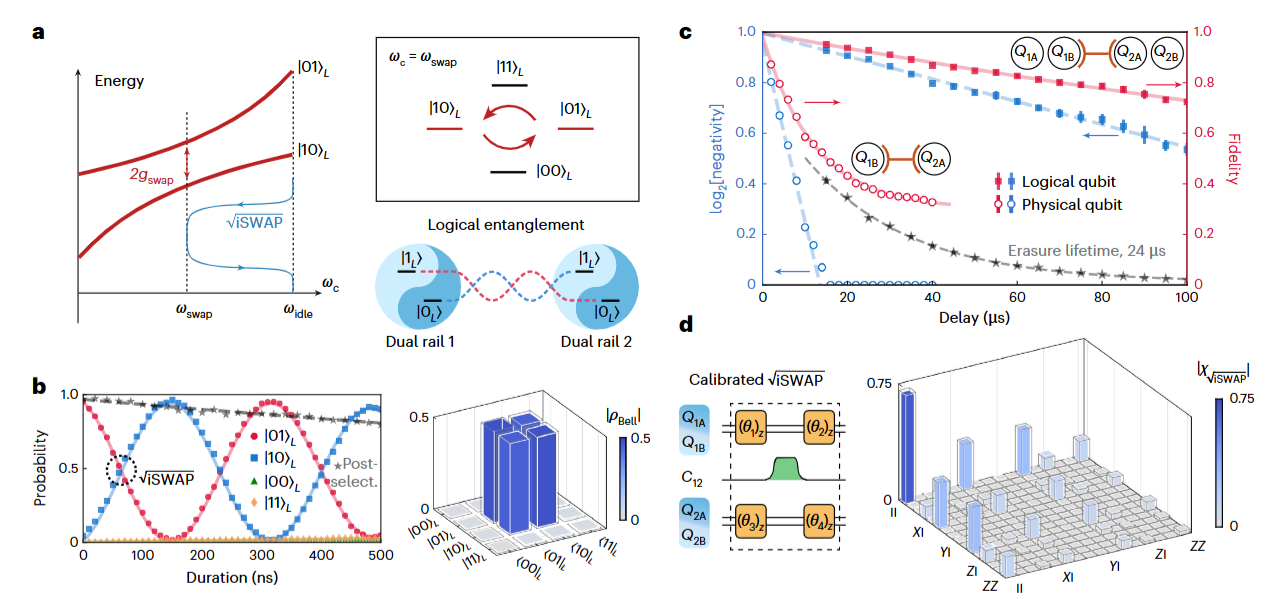
Figure 2. Logical two-qubit entanglement of dual-rail qubits implemented via a tunable coupler
Building upon this foundation, the team further realized tunable coupling between logical qubits and demonstrated high-fidelity logical two-qubit gates within the dual-rail architecture. Using these gates, they generated logical Bell states and three-qubit GHZ entangled states. Notably, the entanglement lifetime of the logical Bell state is approximately one order of magnitude longer than that of its physical counterpart, clearly demonstrating the protection of quantum information enabled by dual-rail encoding combined with erasure detection.
This work marks the first realization of logical entanglement and logical gate operations for dual-rail qubits in superconducting quantum circuits at a multi-qubit level. It shows that this architecture not only provides noise-bias advantages at the single-qubit level but can also be extended to multi-qubit logical operations, representing a critical step toward scalable fault-tolerant quantum computation.
Publication Information
In this work, Ph.D. students Wenhui Huang, Xuandong Sun, and Jiawei Zhang from Southern University of Science and Technology are co-first authors. Assistant Researcher Xiayu Linpeng and Researcher Youpeng Zhong from the Shenzhen International Quantum Academy are the corresponding authors and Academician Dapeng Yu is the last author. This research was supported by the Science, Technology and Innovation Bureau of Shenzhen Municipality, the National Natural Science Foundation of China, Hefei National Laboratory, and the Department of Science and Technology of Guangdong Province.
Paper Link: https://www.nature.com/articles/s41567-026-03211-9